
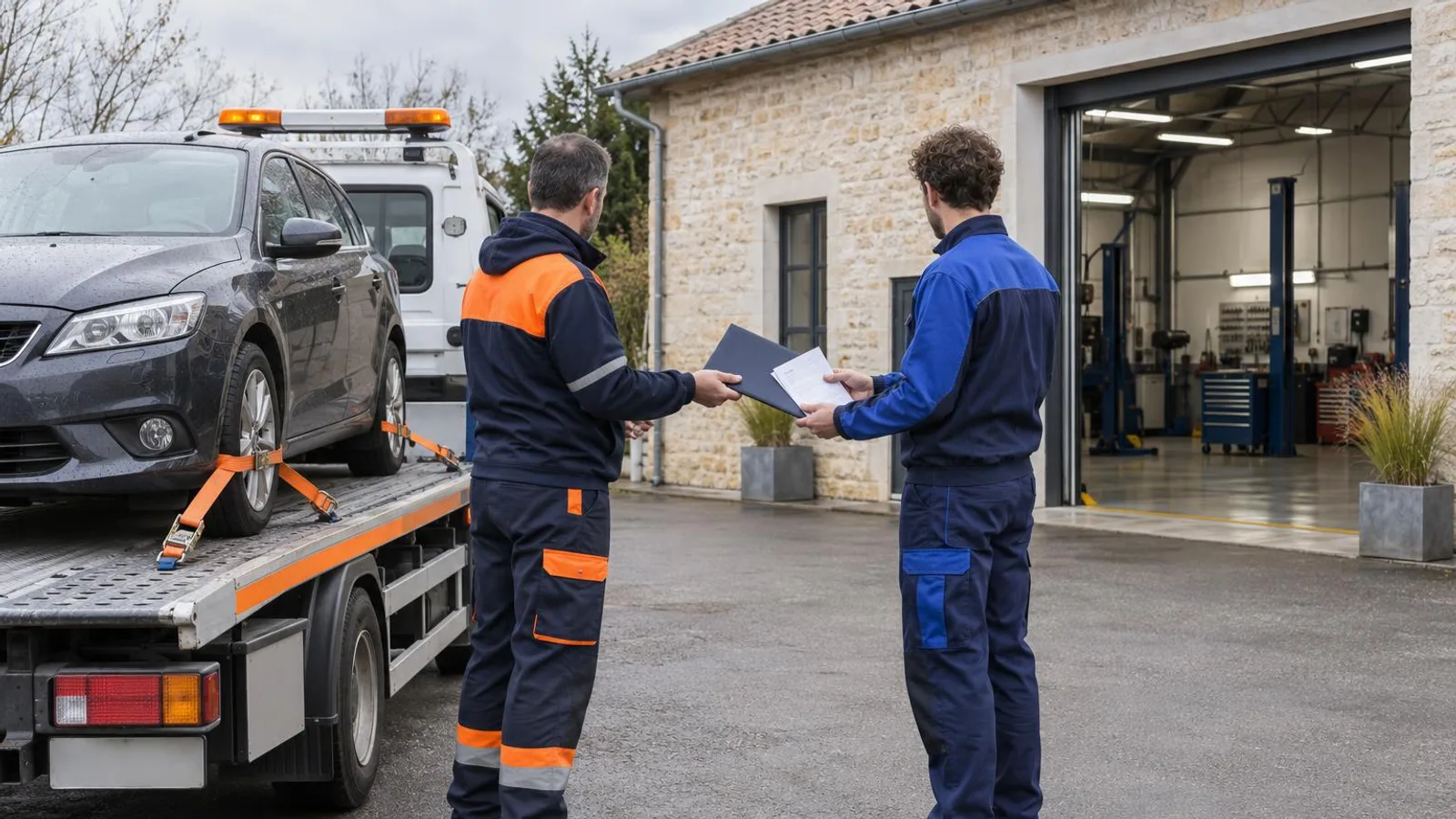
Cross-border towing in Europe is usually coordinated through one assistance case: a coordinator confirms the location and circumstances, dispatches a local provider, identifies a suitable workshop and manages the handovers. The first tow is generally local; any later transport to another country depends on the workshop’s findings, the applicable cover and the required authorisation.
How cross-border towing in Europe starts
When a vehicle stops abroad, the first priority is to establish whether the situation is a routine breakdown or an emergency. If anyone is injured or the vehicle creates an immediate danger, 112 connects the caller to emergency services throughout the EU free of charge. Routine breakdowns should be reported to the relevant insurer or roadside assistance service.
The assistance team needs enough information to locate the vehicle and select the right local resource. A useful first notification includes:
- Exact location. Share a road number, direction of travel, kilometre marker, nearby exit or live map position where possible.
- Vehicle details. Provide the registration number, make, model and any relevant information about the vehicle or load.
- Nature of the problem. Describe warning lights, visible damage, unusual sounds and whether the vehicle can be moved safely.
- People involved. Confirm how many travellers require assistance and whether anyone has additional mobility or medical needs.
- Case and cover details. Give the policy, contract or rental agreement information that allows the assistance team to check authorisation.
The coordinator can then assess whether roadside repair is realistic or whether towing is required. Contacting the insurer or assistance provider before arranging a tow also reduces the risk of using a service that falls outside the agreed cover.
Who coordinates the tow, workshop and communication?
A cross-border case involves several parties, but they should not all have to manage one another. The assistance coordinator acts as the operational point of contact, while local providers carry out the physical roadside work and repair assessment.
A structured case usually moves through these stages:
- Case intake and assessment. The coordinator verifies the location, vehicle, safety situation, cover and immediate need.
- Local dispatch. A towing or roadside provider receives the assignment and confirms whether it can attend.
- Workshop selection. If the vehicle cannot be repaired at the roadside, the coordinator identifies an appropriate local workshop and confirms that it can receive the vehicle.
- Handover. The towing provider transfers the vehicle, keys and relevant case information to the workshop. The case record should show where the vehicle is and who has accepted it.
- Diagnosis and authorisation. The workshop reports what it has found and provides price information or an estimate. The responsible party can then authorise the agreed work or consider another solution.
- Updates and closure. The coordinator follows progress, communicates changes and records the final outcome, documentation and costs.
Clear communication matters most at the handover points. A tow may be completed correctly while the wider case still stalls because the workshop has not received an authorisation, the driver does not know where the vehicle was taken or the next shift lacks the latest status.
Written records help prevent that gap. The European Consumer Centre France advises requesting a written repair estimate, retaining correspondence and requiring approval before a workshop performs additional work or increases the agreed price.
From a local tow to cross-border vehicle transport
Towing and cross-border recovery are related services, but they are not the same operation. A tow removes the vehicle from the breakdown location and normally takes it to a nearby safe place or workshop. Cross-border vehicle transport is a later movement, arranged after the case owner has decided that the vehicle should not remain at the local workshop.
When local repair is possible
If the workshop can complete an authorised repair within an acceptable framework, the vehicle may remain locally until it is ready. The coordinator follows the diagnosis, approval, repair status and release of the vehicle while keeping the relevant parties informed.
The driver may also need onward travel, replacement transport or accommodation while the vehicle is unavailable. These arrangements depend on the applicable assistance product and its authorisation rules.
When the vehicle must move again
If local repair is not the chosen outcome, the case may proceed to vehicle recovery, transport to another workshop, repatriation or disposal. Before transport is booked, the coordinator needs a confirmed destination, vehicle condition, access arrangements, documentation and approval from the party responsible for the cost.
This second movement creates a new chain of responsibility. The releasing workshop, vehicle transporter and receiving location each need clear instructions, while the case handler records collection and delivery milestones. That is why cross-border transport should be treated as a managed case stage rather than an automatic extension of the first tow.
Frequently asked questions
Who arranges towing when a car breaks down abroad?
The driver should normally contact the insurer or roadside assistance provider named in the applicable policy or agreement. That organisation may appoint an assistance coordinator, who dispatches a local towing provider and confirms where the vehicle should be taken.
Does roadside assistance include towing the vehicle home?
Not automatically. Immediate roadside help, local towing and later cross-border transport may be separate benefits, so the applicable cover and authorisation must be checked before vehicle repatriation is arranged.
What should I ask the workshop for after a tow abroad?
Ask for clear price information and a written estimate or repair order before approving work. Keep the correspondence and request written confirmation before any additional work or price increase is accepted.
How we manage European roadside cases
From our 24/7 Alarm Centre in Varberg, we coordinate roadside cases from first notification to closure. Our European roadside assistance service covers dispatch, towing, workshop coordination, onward travel and cross-border vehicle recovery, with structured updates throughout the case.
We work directly with providers in the Nordics, Benelux, the UK and Ireland, with roadside coordination in Germany. Elsewhere in Europe, we work through quality-assured local partners and provider networks. You can read more about how our European provider network works and our assistance model.
For your team, this means one operational point of contact across local dispatch, workshop communication and each handover. If you are reviewing your European roadside setup, talk to us about the countries, vehicles and case flows you need to support.
Sources
- 24/7 Roadside Assistance in Europe, Travel Support Europe, 2026
- Car repairs abroad after a breakdown, European Consumer Centre France, 2025
- 112 – the EU's emergency phone number, European Commission, 2026
- About Us: 24/7 Assistance Partner, Travel Support Europe, 2026
- Join Our European Provider Network, Travel Support Europe, 2026